
Tone practice
Mandarin tone pair practice: from drills to sentences
Tone pairs help because Mandarin tones do not happen one syllable at a time in real speech. The question is how to use them without getting stuck in mechanical drills that never become conversation.
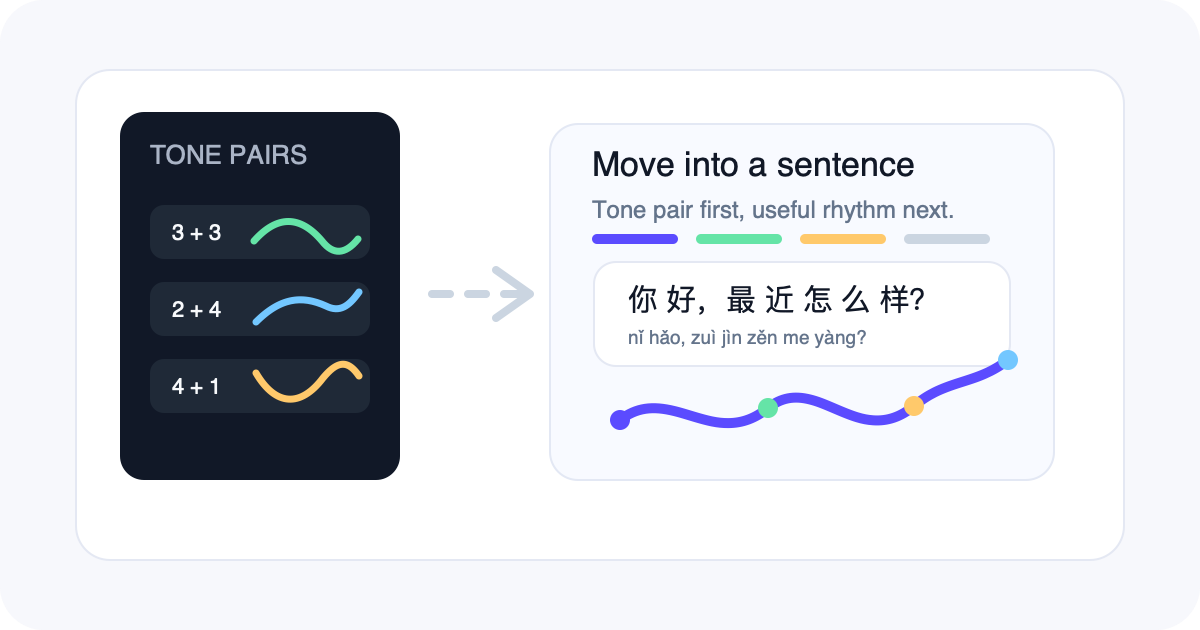
Best use of tone pairs
Use tone pairs to isolate a problem, then immediately move the same pair into a useful sentence. If the tone is correct in a drill but weak in a sentence, the sentence is the real practice target.
Why tone pairs matter
Many learners can produce a tone correctly when it is alone. The problem appears when two tones meet, when a third tone changes shape, or when a fourth tone loses force because the learner is thinking about meaning. Tone pair practice narrows the problem so you can hear and repeat it.
The mistake is stopping there. Chinese speaking does not reward perfect isolated syllables if the sentence still sounds flat. Good practice moves from tone pair to phrase to sentence.
Start with high-value pairs
You do not need every possible combination on day one. Start with pairs that show up in common spoken Chinese: second plus third in "你好", fourth plus fourth in "谢谢", third plus fourth in "我去", and first plus fourth in "今天". Say the pair slowly, then inside a complete sentence.
| Pair focus | Example | Sentence practice |
|---|---|---|
| Second + third | 你好 | 你好,你最近过得怎么样? |
| Fourth + fourth | 谢谢 | 我要一杯冰美式,谢谢。 |
| Third + fourth | 我去 | 我去最近的火车站。 |
Use a three-step routine
First, exaggerate the pair once so your ear hears the shape. Second, say it at normal speed without turning it into singing. Third, put it into a useful sentence and keep the sentence meaning natural. If the tone pair survives all three steps, move on.
If it breaks in the sentence, do not restart the whole lesson. Slow only the weak chunk, repeat it twice, then say the full sentence once. This keeps pronunciation connected to communication.
Check tones in context
A Mandarin tone checker is most useful when it listens to a complete sentence, not only a single syllable. Full-sentence checks reveal whether tones hold up when rhythm, pauses, and meaning are present. Use the result as a practice signal, not as proof of your entire Mandarin level.
Check one sentence before longer practice
Elo's free speaking assessment checks one Mandarin sentence and points you toward the next pronunciation, tone, fluency, or expression target.
Open the Mandarin tone checkerFAQ
What are Mandarin tone pairs?
They are two-syllable combinations used to practice how tones behave next to each other. They are useful because tones change feel when speech becomes connected.
Should I practice tone pairs or full sentences?
Practice both. Tone pairs isolate the pattern. Full sentences prove whether the pattern stays clear when you speak naturally.
How do I know which tone pair to practice?
Use a sentence you actually need, record it, and find the weak tone pattern. The best tone pair is the one that helps your next real sentence.