
AI and human coaching
AI vs human Chinese tutor: which is better for speaking practice?
AI tutors and human Chinese tutors solve different problems. The useful question is what kind of speaking practice you need this week: more repetitions, less anxiety, deeper correction, cultural nuance, or real conversation pressure.
Short answer
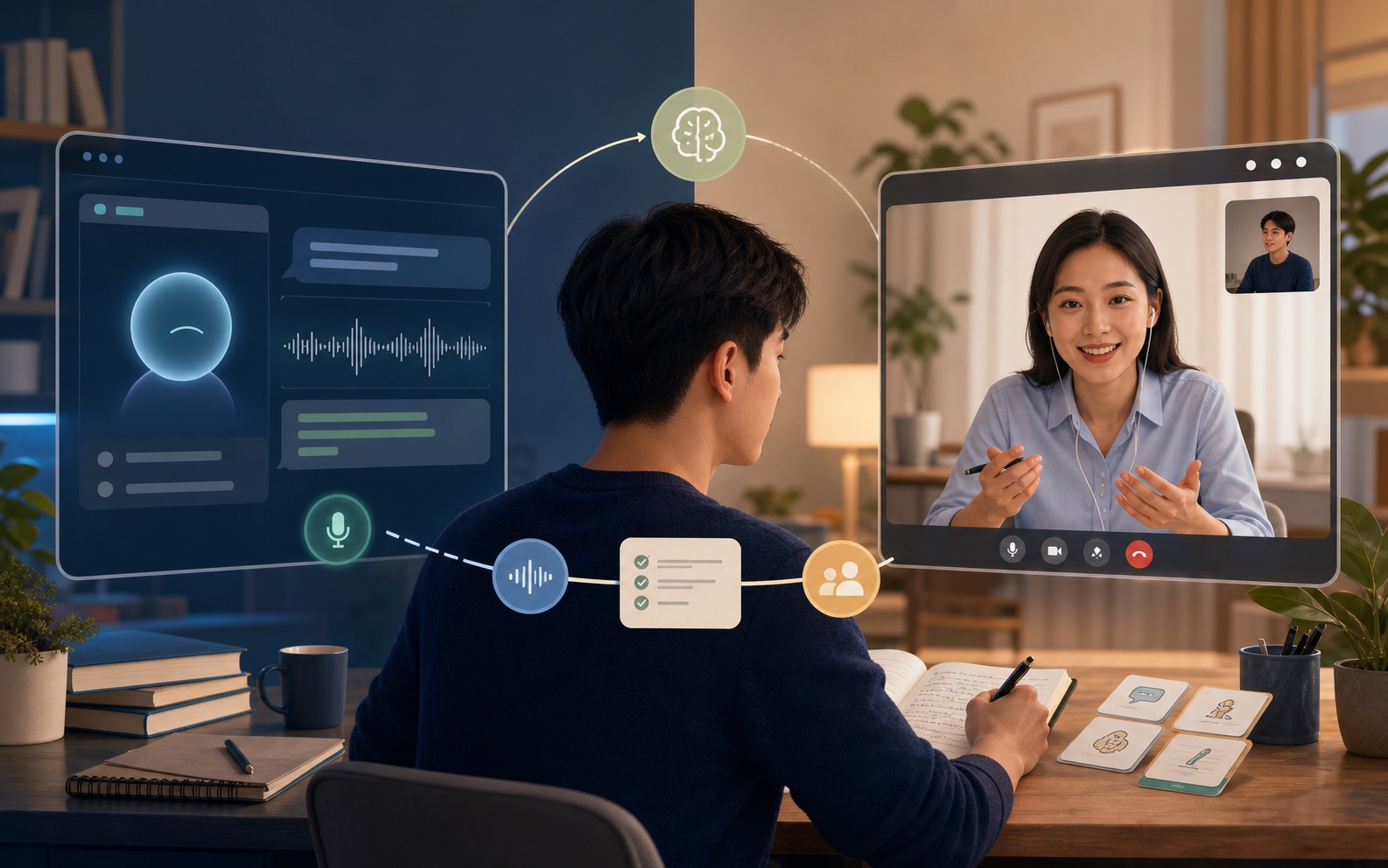
AI is usually better for practice frequency and low-pressure repetition. Human tutors remain stronger for nuance, relationship, cultural context, and accountability. Many learners benefit from using both.
| Need | AI tutor | Human tutor |
|---|---|---|
| Daily repetition | Strong | Limited by schedule and cost |
| Low-pressure confidence | Strong | Helpful, but more socially demanding |
| Cultural nuance | Useful but imperfect | Strong |
| Real conversation pressure | Partial simulation | Strong |
Where AI Chinese tutors are strong
AI is strongest when frequency is the bottleneck. Many learners know they should speak Mandarin every day, but booking a tutor daily is expensive and difficult. AI can give you low-pressure turns at any time. You can repeat the same sentence, ask for another example, or make mistakes without feeling embarrassed.
AI is also useful for activation. A word you recognize while reading may not be available when you need to answer out loud. Short AI conversations help move vocabulary from passive recognition into active speech.
Where human tutors remain stronger
Human tutors are stronger when the conversation itself matters. They can read hesitation, adapt to your mood, interrupt naturally, and explain why one phrase sounds polite while another sounds stiff. They can also connect language to cultural expectations, which is important in workplace, family, travel, and relationship contexts.
A human tutor can notice patterns that an automated correction may miss: avoiding eye contact, overusing one safe phrase, answering too briefly, or sounding memorized. Those are communication issues, not just language issues.
Cost, confidence, and accountability
AI usually wins on availability and cost per practice minute. Human tutors usually win on accountability and judgment. If you are a nervous beginner, AI can help you build enough confidence to show up prepared. If you are preparing for a meeting, exam, or emotionally important conversation, a human tutor can test whether your speech works in a real interaction.
The best approach is often combined
A balanced plan might use AI for daily reps and a human coach once or twice a week. The AI sessions produce volume: more spoken turns, more retries, more small mistakes. The human sessions produce depth: correction, nuance, timing, and confidence under social pressure.
Elo provides AI-only Chinese speaking practice with Elaine and Lee. When recording-owned post-call evidence is ready, transcript-backed Review can help identify a useful next step; feedback may remain processing or limited. Learners choose what to save to Notebook, and only eligible evidence supports learner memory. Human tutoring, when useful, is a separate option outside Elo.
Build a regular AI speaking habit
Start with a five-minute AI sample with Elaine or Lee, no account needed. After signup, new learners receive 60 free practice minutes. Verify your email to use them; the 7-day window starts when your first account conversation connects.
Try 5 minutesHow to decide for your situation
- Choose AI-first practice if you are avoiding speech because you feel embarrassed.
- Choose AI-first practice if you need many repetitions of a topic before meeting a tutor.
- Choose a human tutor if you need cultural nuance, exam feedback, or serious correction.
- Use both if you want high-frequency practice and real conversational accountability.
FAQ
Can AI replace a Chinese tutor?
AI can replace some repetition and low-pressure practice, but not the full role of a skilled human tutor. Real conversation includes timing, personality, culture, and judgment.
Is AI good for learning Chinese?
Yes, when used for the right job. AI is useful for frequent speaking reps, pronunciation retries, vocabulary activation, and confidence building. It works best when paired with review and human feedback.
What can a human tutor do that AI cannot?
A human tutor can respond to social context, explain cultural nuance, notice patterns in your communication style, and create real interpersonal pressure that is hard to simulate fully.