
Exam preparation
How to pass the HSKK oral exam
HSKK preparation is different from ordinary vocabulary review. You are not only trying to know Chinese; you are trying to produce spoken Mandarin clearly, quickly, and under recording conditions.
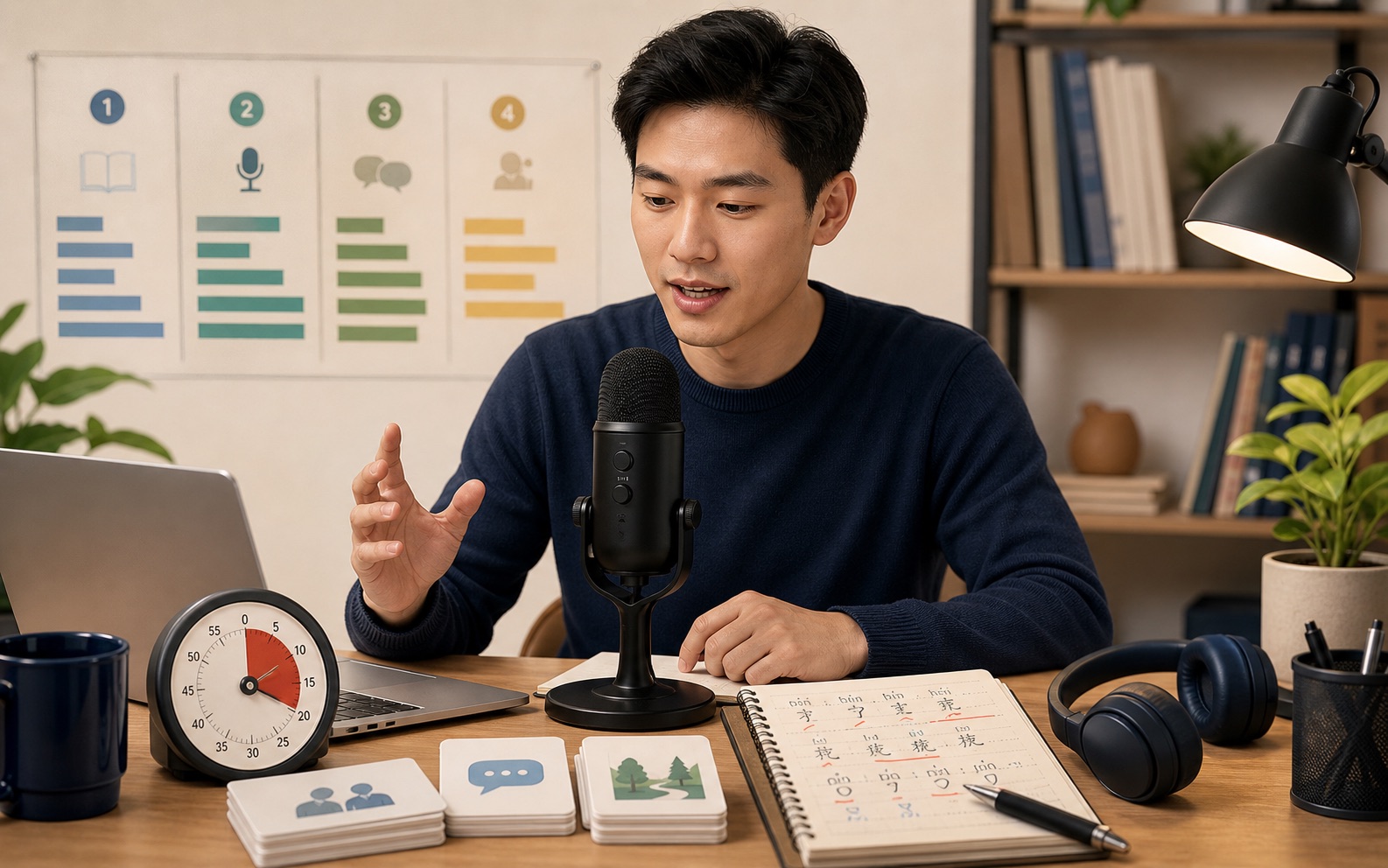
What matters most
Pick the level that matches your real speaking ability, record yourself early, add time pressure before the final week, and get outside feedback on pronunciation and answer structure.
Understand what HSKK is testing
HSKK is an oral exam. That means pronunciation, tone control, sentence completeness, response timing, and confidence all matter. A learner may pass written HSK practice questions but still struggle when asked to speak without a script. This gap is normal. The solution is not only more reading; it is more controlled output.
Before registering, confirm current format, timing, and test-center requirements with the official Chinese test provider or your local test center. Test logistics can change, and local centers may publish practical instructions for recording, equipment, and arrival time.
Common HSKK mistakes
- Memorizing sample answers without practicing flexible sentence building.
- Studying vocabulary silently and assuming it will become fluent speech automatically.
- Ignoring tones when speaking faster.
- Waiting until the final week to record and listen to your own answers.
- Practicing only with written prompts and never with time pressure.
A 30-day HSKK preparation plan
Record short answers
Practice self-introduction, daily routine, food, school, work, family, travel, and opinion sentences. Listen back and mark only two problems at a time.
Build answer frames
Practice patterns like "I think...", "The reason is...", "For example...", and "Compared with..." so new prompts feel less blank.
Add time pressure
Give yourself a prompt, prepare briefly, and record without pausing. If you make a mistake, continue instead of restarting.
Simulate the test
Use full-length practice sessions, review your recordings, and ask a teacher, coach, or advanced speaker to spot patterns you no longer hear.
How AI and human coaching can help
AI practice is useful for daily repetition. It lets you answer many prompts, repeat weak sentences, and reduce embarrassment. Human coaching is useful for judgment: whether an answer sounds natural, whether your tone problem changes meaning, and whether your response fits the communication situation.
Elo offers AI-only practice with Elaine and Lee for frequent HSKK-style speaking reps. When recording-owned post-call evidence is ready, transcript-backed Review can help identify recurring mistakes; feedback may remain processing or limited. Human tutoring is a separate option outside Elo if you want deeper correction.
Practice HSK speaking with feedback
Use short AI practice with Elaine or Lee for repetition. Elo's pronunciation checker can also help you focus on one reference sentence before a longer practice.
Explore HSK speaking practiceFAQ
What is HSKK?
HSKK is the oral Chinese proficiency test associated with the HSK testing system. It focuses on spoken Mandarin and is commonly offered at beginner, intermediate, and advanced levels.
How long does it take to prepare for HSKK Intermediate?
It depends on your current speaking level. If you already have the vocabulary, a focused month of daily output, recording, and feedback can make a visible difference. If you cannot yet form answers comfortably, plan for longer.
Is HSKK harder than HSK?
It tests a different skill. HSK can reward recognition and written understanding; HSKK requires active speech, pronunciation control, and confidence while being recorded.